

Over €1 million in underbilling identified in top 20 customer contracts with DQC
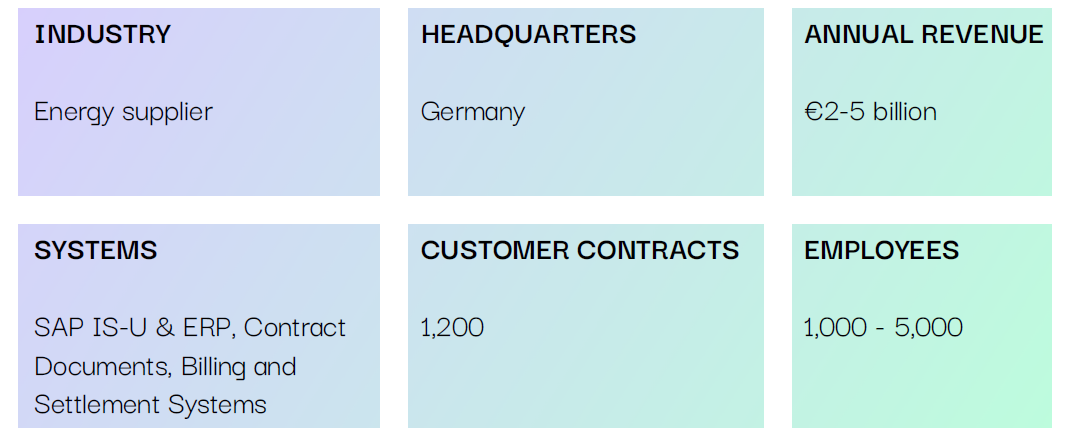
Company profile
Initial situation
The high complexity of major customer contracts, along with amendments, side notes, and appendices, created a challenge for billing. When data is this unstructured, there are many potential sources of error (e.g., incorrectly applied price scales and volume thresholds, incomplete market location (MaLo) and metering location (MeLo) assignments, and unaccounted-for special services).
These problems were further exacerbated by the fact that the relevant data is spread across multiple systems; including contract documents, master data, consumption data, and billing systems. There was no end-to-end linkage of this information, so inconsistencies and the resulting underbilling often went undetected.
Solution
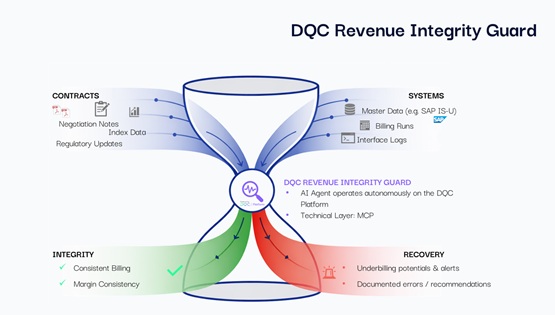
The DQC Revenue Integrity Guard on the DQC Platform systematically analyzed the complex relationships between contracts, billing, and consumption, and automatically identified revenue losses. It did so as follows:
First, the AI agent extracted the contract logic from various documents such as PDFs, attachments, and side letters, and organized it into a structured format.
Next, it automatically reconciled this contract data with the ERP and billing systems, particularly SAP IS-U, to identify discrepancies between target and actual states.
The AI agent then generated a so-called Revenue Integrity Graph, which links the key elements (contract, tariff, MaLo/MeLo, consumption, and invoice) thereby providing a holistic view.
Based on this, automated underbilling checks were performed on the DQC Platform, e.g., to identify missing MeLo in billing, incorrectly applied price scales, or uninvoiced additional services.
Finally, the AI agent prioritized all identified anomalies based on revenue impact, evidence strength, and feasibility to enable targeted and efficient processing of the greatest potential opportunities.
Example
Impact
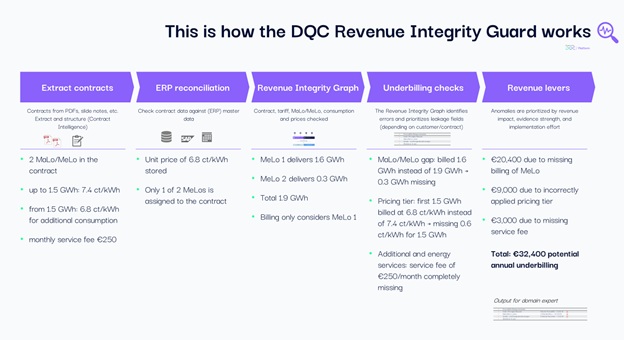
Underbilling of over €1 million was identified in the top 20 major customer contracts. The analysis revealed several specific causes for the revenue losses: In particular, missing consumption volumes due to incomplete MaLo/MeLo allocations resulted in relevant energy volumes not being billed. In addition, pricing tiers were incorrectly applied in some cases, for example, by failing to properly account for threshold values. In addition, uninvoiced service fees and other ancillary services were identified.
All findings were documented with a transparent and auditable breakdown for each individual case, ensuring that the causes are clearly traceable. Based on this, a clear prioritization was established according to economic impact, allowing the greatest revenue potentials to be specifically addressed.
"We were able to identify and realize hidden revenue potential totaling over €1 million. The implementation took just a few hours and was completed within three weeks. Since every euro recovered directly impacts EBIT, we were able to measurably increase our earnings with the help of the DQC Revenue Integrity Guard..”
Director Finance
Outlook
In the future, the solution will be scaled to cover the entire B2B customer base and integrated directly into existing billing processes to enable preventive checks. At the same time, it will be expanded to include additional use cases such as e-mobility and grid and generation-related issues, with the goal of establishing continuous revenue monitoring rather than one-off analyses.
&w=3840&q=75)