

Comparison Guide
Collibra vs. DQC: What are the differences?
Your evaluation guide to navigate data quality
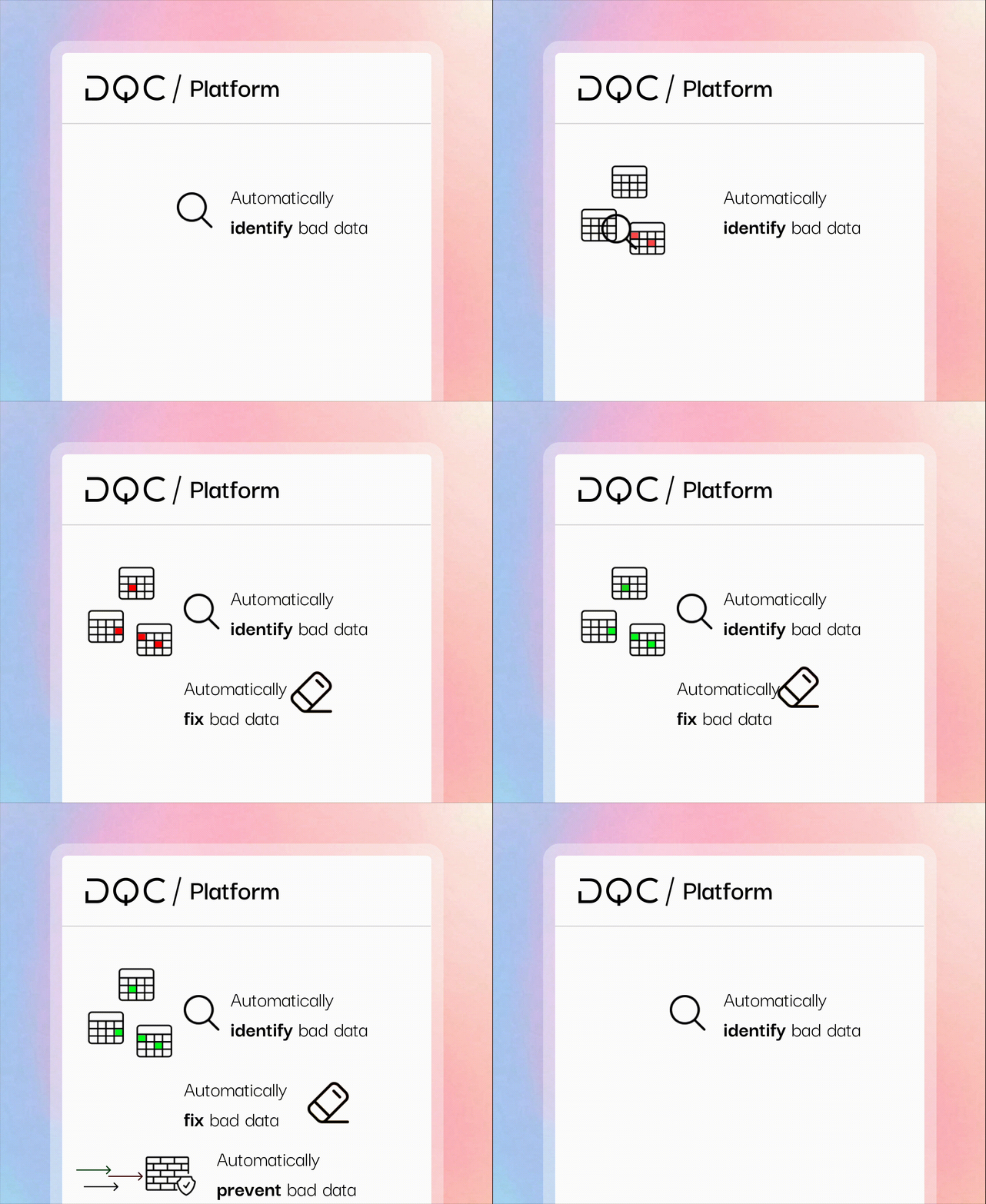
Key differences between DQC Platform and Collibra
Automated & customizable data quality rules with accessible no-code rules, plus SQL/Python checks for advanced users
Agentic data improvement workflows beyond rule-based remediation
Best-of-breed data quality focus, cross-systems vs. suite-based governance approach
1. Automated & customizable data quality rules with accessible no-code rules, plus SQL/Python checks for advanced users
The DQC Platform provides domain-specific data quality logic tailored to the semantics of different data domains such as product, material, and business partner data. Instead of applying generic checks, DQC uses domain knowledge to generate more relevant validations. DQC offers over 40 pre-built no-code rules accessible to business users and provides a conversational approach where users can ask questions like "Suggest completeness checks for this data" or "What consistency rules should I have between orders and inventory?" to get tailored, domain-aware rule recommendations. This results in fewer false positives, higher signal quality, and faster time-to-value compared to a one-size-fits-all approach. Moreover, users can use standard SQL or Python syntax (supported by DQC coding assistants) to check data. Collibra primarily supports rule creation through Text2SQL, where users describe an intended rule and the system translates it into SQL. While this lowers the barrier to writing SQL, users must still know which rules to define upfront. Rule discovery remains largely manual, and even basic checks such as uniqueness or completeness are expressed as SQL rather than accessible no-code configurations. Collibra also offers adaptive, statistically driven rules, but these focus on pattern deviations rather than domain semantics, which can limit relevance in business-critical contexts.
2. Agentic data improvement workflows beyond rule-based remediation
The DQC Platform uses agentic improvement workflows that allow business and technical users to define context-aware fixes together. The DQC AI improvement agent has different tools at its disposal to complete a data improvement task. High confidence improvements can be applied automatically, while uncertain cases are reviewed by humans, enabling scalable enrichment, validation, and correction use cases. Collibra primarily focuses on detecting and monitoring data quality issues through automated profiling, adaptive rules, and anomaly detection. While Collibra provides workflows for issue management, task assignment, and stakeholder notifications, actual data remediation typically happens outside of Collibra in external tools or requires manual intervention through separate systems, with Collibra serving only as the detection layer.
3. Best-of-breed data quality focus, cross-systems vs. suite-based governance approach
The DQC Platform is specialized on data quality checks and improvements and deliberately integrates best-of-breed tools for adjacent capabilities instead of replacing them. Quality signals, rules, and improvement results can be exposed directly into existing catalogs, BI tools, and workflows where users already work, while DQC remains fully focused on high-quality execution across the entire data quality lifecycle (find, improve, prevent). This specialization allows DQC to advance data quality capabilities more rapidly and in greater depth across discovery, improvement, and prevention. Collibra’s suite-based model requires prioritization across multiple governance domains, which can limit how quickly and deeply data quality-specific capabilities evolve. While this creates tight coupling between data quality checks, governance policies and ownership structures, organizations using Collibra commit to a broader ecosystem where data quality is one module among many, and feature prioritization balances needs across catalog, lineage, privacy compliance, and governance workflows rather than exclusively advancing data quality depth and realizing business value. DQC works for you in days, not months.