

Comparison Guide
Ataccama vs. DQC: What are the differences?
Your evaluation guide to navigate data quality
Key differences between DQC Platform and Ataccama
Agentic data improvement workflows beyond rule-based remediation
Domain-optimized data quality checks and improvements
Best-of-breed data quality focus vs. suite-based approach
1. Agentic data improvement workflows beyond rule-based remediation
The DQC Platform uses agentic improvement workflows that allow business and technical users to define context aware fixes together. The DQC AI improvement agent has different tools at its disposal to complete a data improvement task. High confidence improvements can be applied automatically, while uncertain cases are reviewed by humans, enabling scalable enrichment, validation, and correction use cases. Ataccama relies mainly on rule-based remediation and record editing, which works well for deterministic fixes but is less flexible for context driven improvements.
2. Domain-optimized data quality checks and improvements
The DQC Platform provides domain-specific data quality logic tailored to the semantics of different data domains such as product, material, and business partner data. Instead of applying generic checks, DQC uses domain knowledge (e.g. identifier logic, attribute dependencies, cross-table relationships, and business rules) to generate more relevant validations and improvement workflows. This results in fewer false positives, higher signal quality, and faster time-to-value compared to a one-size-fits-all approach. Ataccama primarily relies on more generic, configurable rule frameworks that require stronger manual modeling to reach similar domain depth.
3. Best-of-breed data quality focus vs. suite-based approach
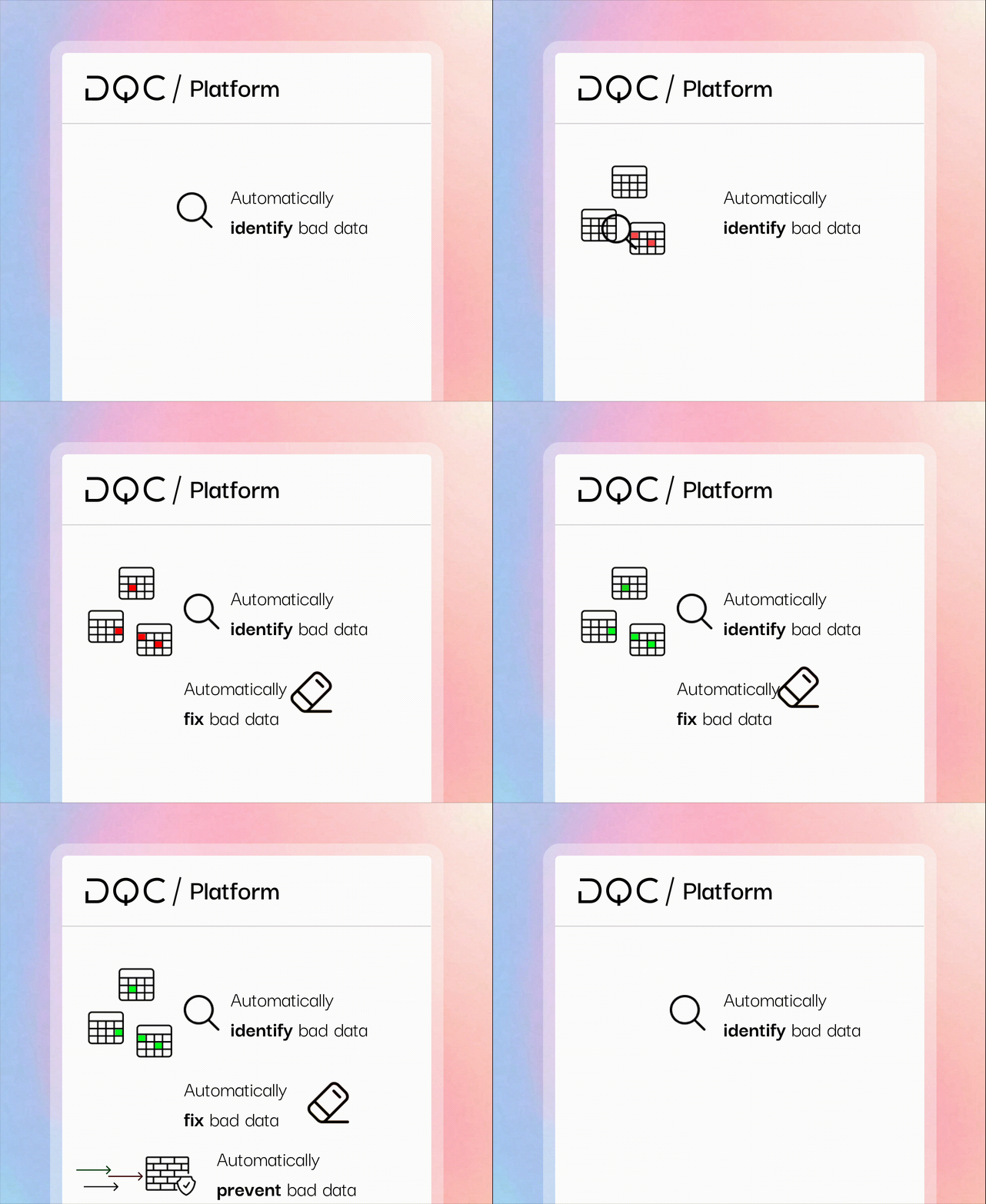
The DQC Platform is specialized on data quality checks and improvements and deliberately integrates best-of-breed tools for adjacent capabilities instead of replacing them. Quality signals, rules, and improvement results are exposed directly into existing catalogs, BI tools, and workflows where users already work, while DQC remains fully focused on high-quality execution across the entire data quality lifecycle (find, improve, prevent). Ataccama on the other hand follows a suite-based approach that bundles data quality with catalog, glossary, and lineage capabilities in a tightly integrated stack.