
Participant selection for alerts
In the DQC Platform, participants are the recipients of alert notifications. When data quality issues are detected after a table check, alerts automatically notify selected users—ensuring timely responses and smooth operational workflows.
Participant Setup Options
You can configure one or more participant groups per alert. Each group is defined by its communication channel and user selection logic.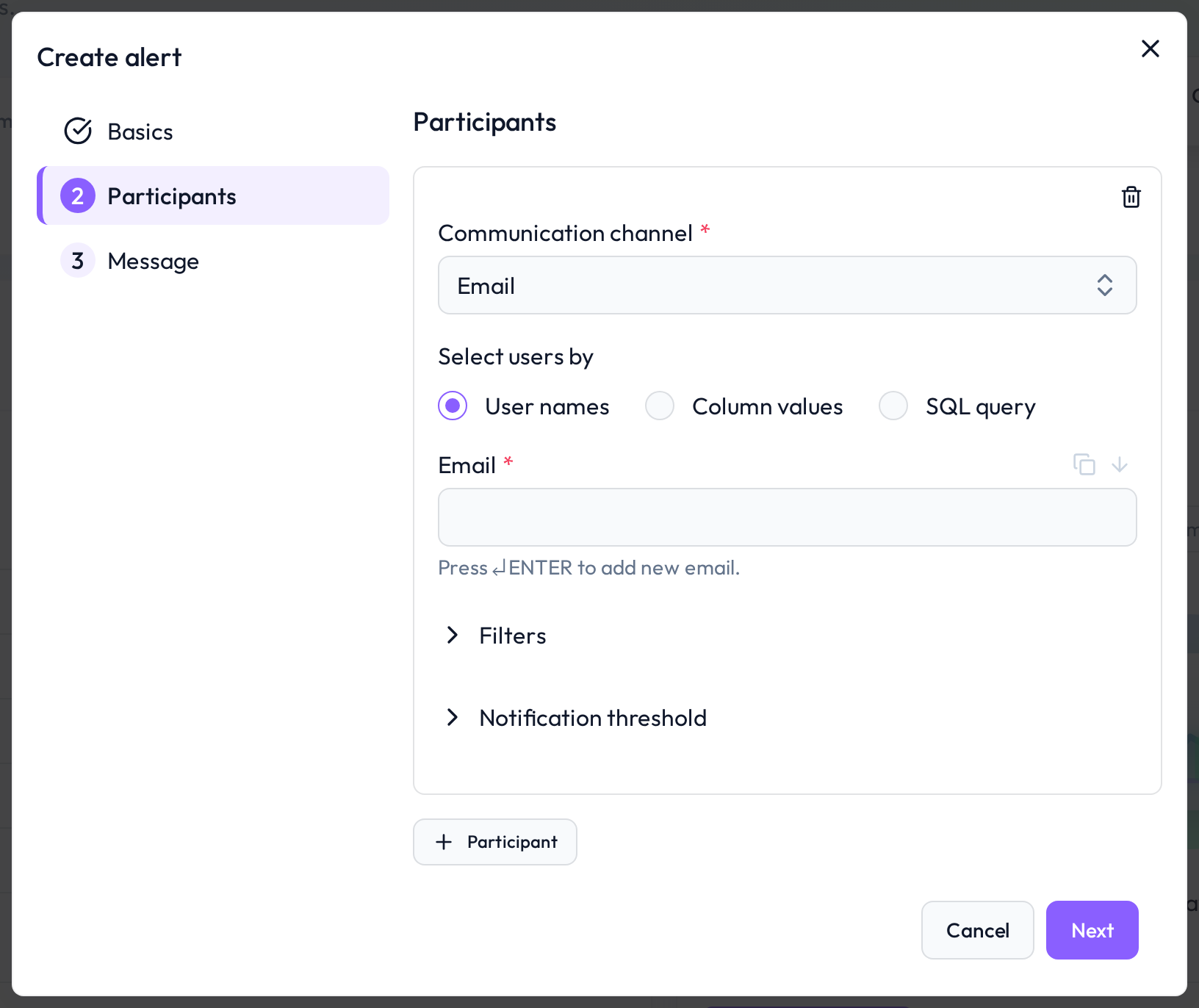
Communication channel
Choose how participants will receive alert messages:
Email – Sends notifications to individual email addresses
MS Teams chat – Sends direct messages to individual users
MS Teams channel – Sends group messages to a channel
Select users by
For Email and MS Teams chat there are three methods to define participants (for MS Teams channel you select the configured channels instead):
User names – Enter email addresses, or search and select people for MS Teams chat
Column values – Use a column in the table that contains recipient data
SQL query – Use a query to dynamically fetch recipients from the data
Filters (optional)
You can narrow the scope of assigned issues with filters:
Rules filter – Only send issues for specific rules
Rows filter – Target specific entries based on column values
Notification threshold (optional)
To avoid message overload, you can define a minimum threshold that must be met before sending a notification. The threshold is evaluated on the rules selected in a rules filter, or on the whole ruleset if no rules filter is set. It cannot be combined with a rows filter.
Choose one of two methods:
Absolute – Minimum number of issues
Relative (Quality status) – Threshold in percent: the notification is sent when the quality ratio is at least this many percentage points below 100% (for example, 10 means a quality ratio of 90% or lower)
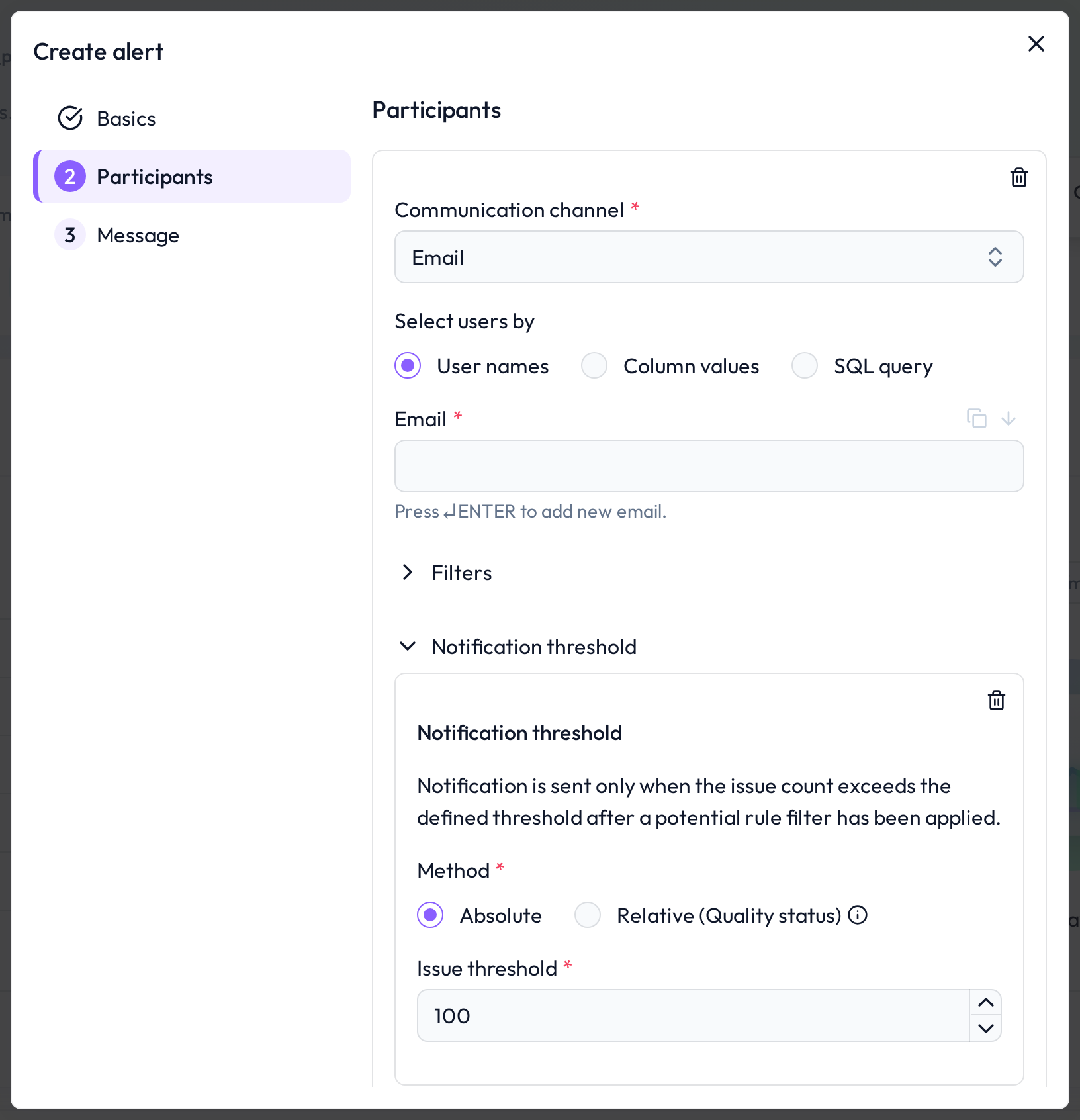 In this case, the email participant will only be notified if 100 or more issues are found
 Notes
You can define multiple participant groups with different filters and channels
Notification thresholds are useful for focusing user attention
Learn more: Alert overview, Buttons in alerts